
Publication In Focus: Prognostication in skin cancer


Predicting the outcomes of skin cancer remains challenging, despite the advancement of tools that are available in the clinic. There is now a growing number of studies investigating the use of gene expression profiling in order to further our ability to diagnose and predict outcomes in skin cancer. Gene expression profiling uses gene expression levels as a prognostic tool to predict recurrence risk or response to adjuvant therapies and is being introduced into clinical practice.
This Publication In Focus highlights four key papers that are contributing to these advancements, investigating the use of gene expression profiling in cutaneous melanoma and cutaneous squamous cell carcinoma.
Guidance of sentinel lymph node biopsy decisions in patients with T1–T2 melanoma using gene expression profiling
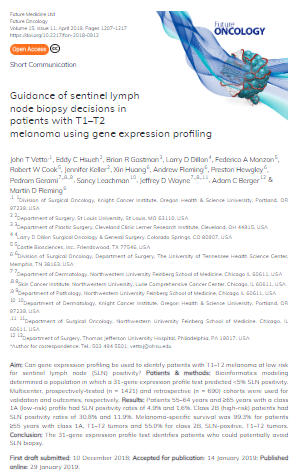 Aim: Can gene expression profiling be used to identify patients with T1–T2 melanoma at low risk for sentinel lymph node (SLN) positivity? Patients & methods: Bioinformatics modeling determined a population in which a 31-gene expression profile test predicted <5% SLN positivity. Multicenter, prospectively-tested (n = 1421) and retrospective (n = 690) cohorts were used for validation and outcomes, respectively. Results: Patients 55–64 years and ≥65 years with a class 1A (low-risk) profile had SLN positivity rates of 4.9% and 1.6%. Class 2B (high-risk) patients had SLN positivity rates of 30.8% and 11.9%. Melanoma-specific survival was 99.3% for patients ≥55 years with class 1A, T1–T2 tumors and 55.0% for class 2B, SLN-positive, T1–T2 tumors. Conclusion: The 31-gene expression profile test identifies patients who could potentially avoid SLN biopsy.
The 31-gene expression profile stratifies recurrence and metastasis risk in patients with cutaneous melanoma
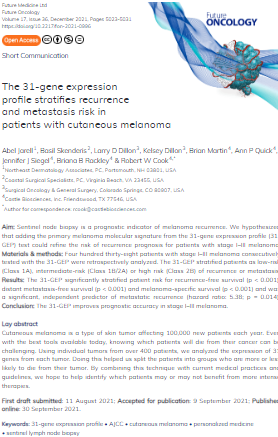 Aim: Sentinel node biopsy is a prognostic indicator of melanoma recurrence. We hypothesized that adding the primary melanoma molecular signature from the 31-gene expression profile (31-GEP) test could refine the risk of recurrence prognosis for patients with stage I–III melanoma. Materials & methods: Four hundred thirty-eight patients with stage I–III melanoma consecutively tested with the 31-GEP were retrospectively analyzed. The 31-GEP stratified patients as low-risk (Class 1A), intermediate-risk (Class 1B/2A) or high risk (Class 2B) of recurrence or metastasis. Results: The 31-GEP significantly stratified patient risk for recurrence-free survival (p < 0.001), distant metastasis-free survival (p < 0.001) and melanoma-specific survival (p < 0.001) and was a significant, independent predictor of metastatic recurrence (hazard ratio: 5.38; p = 0.014). Conclusion: The 31-GEP improves prognostic accuracy in stage I–III melanoma.
Integrating 31-Gene Expression Profiling with clinicopathologic features to optimize cutaneous melanoma sentinel lymph node metastasis prediction
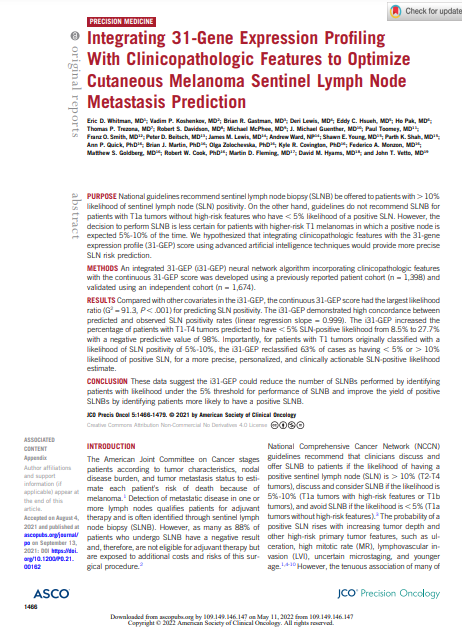 Purpose: National guidelines recommend sentinel lymph node biopsy (SLNB) be offered to patients with > 10% likelihood of sentinel lymph node (SLN) positivity. On the other hand, guidelines do not recommend SLNB for patients with T1a tumors without high-risk features who have < 5% likelihood of a positive SLN. However, the decision to perform SLNB is less certain for patients with higher-risk T1 melanomas in which a positive node is expected 5%-10% of the time. We hypothesized that integrating clinicopathologic features with the 31-gene expression profile (31-GEP) score using advanced artificial intelligence techniques would provide more precise SLN risk prediction. Methods: An integrated 31-GEP (i31-GEP) neural network algorithm incorporating clinicopathologic features with the continuous 31-GEP score was developed using a previously reported patient cohort (n = 1,398) and validated using an independent cohort (n = 1,674). Results: Compared with other covariates in the i31-GEP, the continuous 31-GEP score had the largest likelihood ratio (G2 = 91.3, P < .001) for predicting SLN positivity. The i31-GEP demonstrated high concordance between predicted and observed SLN positivity rates (linear regression slope = 0.999). The i31-GEP increased the percentage of patients with T1-T4 tumors predicted to have < 5% SLN-positive likelihood from 8.5% to 27.7% with a negative predictive value of 98%. Importantly, for patients with T1 tumors originally classified with a likelihood of SLN positivity of 5%-10%, the i31-GEP reclassified 63% of cases as having < 5% or > 10% likelihood of positive SLN, for a more precise, personalized, and clinically actionable SLN-positive likelihood estimate. Conclusion: These data suggest the i31-GEP could reduce the number of SLNBs performed by identifying patients with likelihood under the 5% threshold for performance of SLNB and improve the yield of positive SLNBs by identifying patients more likely to have a positive SLNB.
Enhanced metastatic risk assessment in cutaneous squamous cell carcinoma with the 40-gene expression profile test
Aim: To clinically validate the 40-gene expression profile (40-GEP) test for cutaneous squamous cell carcinoma patients and evaluate coupling the test with individual clinicopathologic risk factor-based assessment methods. Patients & methods: In a 33-site study, primary tumors with known patient outcomes were assessed under clinical testing conditions (n = 420). The 40-GEP results were integrated with clinicopathologic risk factors. Kaplan–Meier and Cox regression analyses were performed for metastasis. Results: The 40-GEP test demonstrated significant prognostic value. Risk classification was improved via integration of 40-GEP results with clinicopathologic risk factor-based assessment, with metastasis rates near the general cutaneous squamous cell carcinoma population for Class 1 and ≥50% for Class 2B. Conclusion: Combining molecular profiling with clinicopathologic risk factor assessment enhances stratification of cutaneous squamous cell carcinoma patients and may inform decision-making for risk-appropriate management strategies.
Podcast: Using 40-GEP to enhance metastatic risk assessments in cutaneous squamous cell carcinoma
In this episode of OCTalks, Dr Ibrahim discusses cSCC and current metastatic risk assessments used for staging the disease, as well as their recent study investigating 40-GEP.

This infographic visualizes the studies key objectives, study design and outcomes.

This article feature highlights the key points of the study in a short summary.